LEAVE YOUNG BIRDS BE!!


Please, do not hamper a young bird's life by picking it up, and taking it home with you. It is calling its parents to help them in locating it.
After fledgling from the nest, the parent birds will keep feeding it, and look out for it, until it will be able to look after itself.
And the reason you cannot see a parent is because of your own proxomity to the young bird. And while you are ebating if or not you should take the bird home, you keep the parent from giving it well needed nutrition in the form of a meal!


Photos

The photos on this blog are all taken by me. If there is any picture you might want to use for any other than personal use, please drop me a line to the email address shown in the sidebar on the right.
Showing posts with label waders. Show all posts

Monday, December 5, 2011

A couple of local Waders and others.

Curlew, Numenius arquata


Hooded Crow, Corvus cornix

I've long been saying that Corvids like the Hooded Crow, Corvus cornix, the Jackdaw, Corvus monedula, the Rook, Corvus frugilegus, and the Red-billed Chough, Pyrrhocorax pyrrhocorax, act more like shorebirds than landbirds. Well, they do here anyway. Sometimes I wonder if they might even end up with webbed feet in a few more millenia? Just look in your local harbour or coastline. Just like you will see the Pied Wagtail, Motacilla alba, there also.
(Yes, this picture is dedicated to fellow blogger, Old Crow. She, like me loves Corvids, but unfortunately for her, the Hooded Crow has not crossed the Atlantic yet.)
The Raven, Corvus corax, likes feeding on coastal areas too. There is one living on the north side of the Sheep'shead Peninsula, which came feeding in a friend's garden during the harsh 2010/2011 winter.


Common Redshank, Tringa totanus

The Redshank is one of my favourite waders; they are so dainty and their bright red-orange legs light up the grey of the slobs.


And further on, another pair of scarlet tights, this time they were hidden from view though.


Black headed Gull, Larus ridibundus


Oystercatcher, Haematopus ostralegus

I've been checking for the Common Teal, Anas creca, to arrive to our little estuary in Dunmanus Bay, but when I thought I spotted the ruddy head of the male, it turned out to be the green head of the male Mallard, Anas platyrrhyncos. This was a bit of a disappointment for me, really.


Sorry that I have not been posting for some time now. I'm going through a bit of a rough patch, really.

Tuesday, September 27, 2011

Grey Heron, Aredea cinerea

This heron flew up from just below the wall along the estuary, and just landed at the other side.

This youngster just wants a little attention

Great Tit, Parus major, searching for grubs amidst the weeds.


All this searching makes one vry thirsty

male House Sparrow, Passer domesticus

And this photo is posted specially for a Canadian blogger, under her Google name of Old Crow. I know that she loves this specie's handsome plumage.
So this Hooded Crow, Corvus Cornix, is fpr you!


Female Chaffinch, Fringilla coelebs.

The number of Chaffs is increasing almost daily; the migrants are arriving from the continent and the Chafflings have now moulted into the adult plumage. They are one of my favourite species, they have very special characters, I think.

Katja, my homehelp, reported that another bird has been killed; she saw a lot of feathers underneath the feeders at the shed.
So I've shifted the big Fatsia japonica next to the shed, hopefully the large leaves will now block the felines.

Sunday, March 13, 2011

my white capped house Sparrow, Passer domesticus.

The other day, I spotted this little House Sparrow, Passer domesticus, whose head seemed very strange


There are no white flowers in flower in this area; so it is not pollen. (my Blue Tits will often show up with heads in summer, covered in pollen. )
Any ideas?

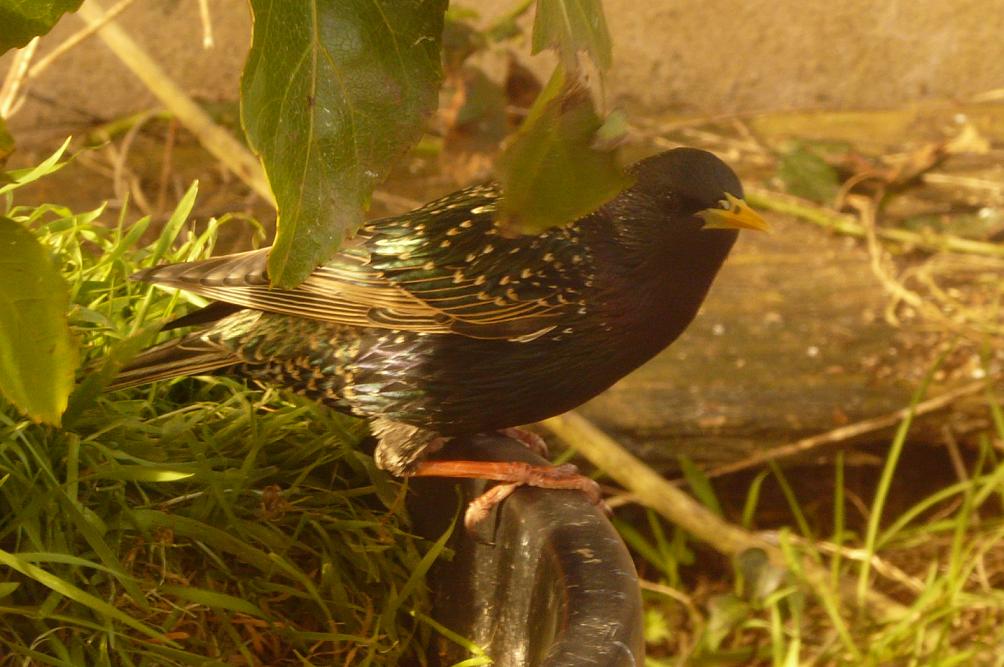
Starling, Stumus vulgaris

The starlings have now discovered the fatball feeder at the front of the house, which is used as battleground between the male Sparrows and the Chaffinches like to play their part in it also.

male Blackcap, Sylvia atriciapilla


Greenfinch, Chloris chloris

A rare moment of a territorial Sparrow sharing with, surprises this little Coal Tit, Parus ater

Trying to find that tastiest nut? Great Tit, Parus major.

male Chaffinch, Fringilla coelebs.
Each day, I get about 20 Chaffinches feeding here.


Blackheaded Gull, Larus ridibundus.
Ready to pounce & dive...

or perhaps not.


And across the estury, Curlew, Numenius arquata

Little Egret, Egretta gazetta


I had not been out onto the road since December, due to the ice, and snow at first and then because of Francis being ill. So it was great to visit my local patch again.

Wednesday, July 22, 2009

Juvenile Pied Wagtail High Herons

Above the village road to the bay, it is mostly very noisy; some of the Rooks nest and roost in a couple of large Scotch Pines which grow at the back of the garden of what used to be a small shop in the front room of a residential house. Ideal for that pint of milk, tin of dogfood or bag of flour, you'd forgotten, and didn't fancy a 20min. round trip in the rain without a roof over your head. So instead you'd come to Mrs. Donovan, which would take at least half the time. The garden, most of it lawn for the grandchildren, backs onto a tidal river, often a respite for the Mute Swans and other waterfowl.

The other day I sat watching a play with two star characters:
The Parent Pied Wagtail, Motacilla alba.
and
the Juvenile Pied Wagtail, Motacilla alba

It was quite comical to watch the Parent foraging with the Kid following eagerly for the next worm or Insect.
The Kid went of exploring on its own too, of course; one needs to find out what is behind that shrub, evelation, or tree.


In short, I spend a delightful time here at the side of the road, my eyes, camera and bins transfixed on the theatre set.

Next I rode on along the bay, looking longingly towards the pier. The breeze, as ever, was too strong to go and sit here out into the open, so I decided against it, and as I watched the Sea Asters, which finally were coming into bloom. I'd been waiting for these little little Wild Flowers, which last summer attracted so many Small Tortoiseshell Butterflies. I have only seen a few of these yet, which I do hope will be changing soon. To be honost, the ones I did see this summer, were all back in the garden. As I looked down, I spotted a Gull flying up, while I was thinking how odd it was to see a totally white one. Besides this strange plumage, I noticed that it would be too large for one too. I've seen big Great Black backed Gulls, Lesser Black backed or Heron Gulls, but this one beat all of those. Not that these were all white, far from it!
Following it, it landed in a across the bay. Heading back to the Church of Ireland, I spotted two Little Egrets in one tree, another Little Egret and Grey Heron in another, nearby.

The discovery of the latter was odd and yet it brought a smile to my face. The Grey Herons breed and rooast in a tree across the pier, and usually fish here too. The Egrets I had not seen in the bay since last year. I've seen Little Egrets in Bantry Bay, but not here in Dunmanus Bay. they have eluded me since. Whenever I would see the 'white Herons' here, one Grey Heron had been with them, everytime.
I am sorry, it was too far across for my dear Lumix. Besides the problem of distance, the other was white blobs in the tree. The sun was beaming right onto the birds, and even adjustments couldn't change this, without any visible details.

The botanical photos will be on Wildlife on Wheels. Not many either, because the break in the clouds was not very tolerable; wind and looming rain meant that I soon had to turn back again.

Yet it had been fun observing the Wagtails. I love juvenile Wagtails, their grey colour reminds me a bit of female Chaffinches, which would probably love such a large black bib too!

Tuesday, March 10, 2009

Rendez vous at Dunmanus Bay.

Today for the first time since weeks, I had the chance to get further from home than the Eddy's shop and the post office. The Sun was out and although JJ and my Coal Tits were trying to keep me up here at base, I simply had to go.

Since somewhere late I had not seen the little Common Teals (small Ducks) and I really wished to meet them again, before they would leave for their nesting grounds.
I have always assumed that the Teals were migratory birds, but my book is telling me that the SW corner of this island has residential Teal. Yet I never see them in summer, or anytime other than late autumn/winter or at other visits to the bay during the winter.
Before I spotted the Ducks in the bay, I was bombarded by the usual cacophony of the many Rooks and Hooded Crows repairing their nests in the large trees along the river at the church of Ireland. Although I tried, I was unable to get any shot of them. Sorry, Crow. (other time again!)
I was tempted to get up to my little "botany backroad", to see if the flock of LTTs or the Goldcrests were about. Mine might have perished, (this I assume because I haven't seen them since the cold spell hit these islands. However, the wind, very much down on previous days/weeks, was still bothering me too much.

After a little Sunny chat with a friend and her 3 dogs, en route to the school, I was glad to see parents still doing the walking school run, deciding to leave the car at home.
OK, many parents live out of the village, and a good few miles via the main road, but those who live just like my friend, between 1km-1 mile, should really let their kids get the experience of the road. It might not sound like much, compared with city traffic, I think we shuold start here. Kids should get used to either go walking, or cycling and it is quite a lot safer than the UK, yet even I would not let my kid, if I had any, out onto the main roads here. The traffic there is ruthless and it can even scare my wheels now and then. :)

As I turned onto the main road at the church of Ireland, about 5 birds were flying low over the water, and although I was unable to recognise their calls, a brief flash of black and white made me think that these were the ones I had been wanting to meet today! One or two landed on the water, close to the road, and I rode a little faster, while still trying to be as quietly as possible. From a distance, I had the feeling that they were far too small for my little Ducks, and my heart sank again. Yet the possible candidates, Black headed Gulls and Redshank, had no b&w markings on their wings nor any parts of their body. As quick as the birds had landed, they flew off again in the direction of the other bank, avross the bay. My sweet little Panasonic had not enough strength to reach that far, so her heart started sinking also.
In the end they congregated around the piece of piece of land sticking out into the bay, where the larger birds, Little Egrets, Grey Herons, Whimbrel, and Cormorants keep watch, and on which the Cormorants have "their tree" (totally empty now)

My camera had been able to shoot nice pictures of birds sitting there, I would have to do a little cropping for these photos,as these Ducks are quite a bit smaller.
My flexible case of my little bins would need another clean, I saw when taking these out, which needs doing quite regularly because the case is 'clipped onto my wheels. This way I am never without them. and also, they might be small, but I have no opportunity to bring them otherwise. I can hang shopping on the back of my wheels, for other people to remove it again, because there is no way I can reach any bag on the back. And if my neck was strong enough to have anything dangling from it, my bins would be in the way of my camera's bag which is on my lap.
In the end I was only able to get one or two shots; the wind increased and rain was getting too close. (which started indeed before I was home)

Redshank:

Common Teal:

jj, our juvenile (well, 9 months old) Jackdaw,


House Sparrows in the garden:


Earwig, on my table in the kitchen, on the first tentative step to stardom: