LEAVE YOUNG BIRDS BE!!


Please, do not hamper a young bird's life by picking it up, and taking it home with you. It is calling its parents to help them in locating it.
After fledgling from the nest, the parent birds will keep feeding it, and look out for it, until it will be able to look after itself.
And the reason you cannot see a parent is because of your own proxomity to the young bird. And while you are ebating if or not you should take the bird home, you keep the parent from giving it well needed nutrition in the form of a meal!


Photos

The photos on this blog are all taken by me. If there is any picture you might want to use for any other than personal use, please drop me a line to the email address shown in the sidebar on the right.
Showing posts with label Rooks. Show all posts

Thursday, July 7, 2011

Black and white wings

Collared Doves, Streptopelia decaocto and Jackdaw, Corvus monedula.

Collared Dove and Rook, Corvus frigulegus

Jackdaws feeding- not always agreeing!

One of the Jackdaw juveniles, being fed by a parent.

and asking for more as soon as mum or dad leaves.

Each year I would be looking forward to our Jackdaw fledglings. This year, however, after Francis' death, I've been concentrating on the garden, and creating my own space in the workroom again. And because I spent less time in the kitchen, I missed the first arrivals and although I've heard and briefly seen the young Rooks and Jacks, I've not taken the time to sit and photograph them. Better luck next year again.

We do have a lot of Magpies, Pica pica, at the moment.

Thursday, June 2, 2011

A quick peek around the garden

House Sparrow, Passer domesticus


And Dad of course

Dunnock, Prunella modularis


Blue Tit, Parus caeruleus

Great Tit, Parus major


Robin, Erithacus rubecula

Having had Frouke over from Holland to spend a week here and help with painting the living room, bathroom, and helped me with clearing much of Francis' stuff, has helped me a lot. The help I really need, however, like the PA, is still a long way off. With no money available, the fact that there is a waiting list of 13 applicants is a depressing thought, and after 5 months of hearing that there are no funds available, I am getting the impression it might take up to a year at least to get some sort of result.
It just makes you realise how spoilt I was to have Francis as my 24/7 carer. And I still cry several times a night and also many times a day.


Chaffinch, Fringilla coelebs

Young Rook from last year.

Tuesday, December 7, 2010

Worries about my Rooks.

Click on the photos for a better view.
This Rook, a juvenile still, has somehow broken the tip of its lower mandible. The upper mandible's tip has now grown downward. Over time the two mandibles will chafe away their original shape as has been happening already.


And here's another Rook, another juvenile unfortunately. He/she also broke the mandible. Very similar break to the first one. This one however looks to be in a worst state health-wise.
The school next door has been closed for many days over the last 2 weeks. This had a major impact on our Rooks, Jackdaws and Hooded Crows, which usual feed there during break times. Blackbirds and Song Thrushes took advantage of this by moving into the garden. The Corvids are back now with the school open today, but I have seen them that much recently. They still feed here, but it seems that the Thrushes have enough power to keep Corvids on the fence.
A full head of feathers like this one is what attracts me to the Rook. (and that cheeky character of course.)

Loss of feathers is apparent in this bird:
it could be suffering from that disease that usually hits Jackdaws. But as these feed togeter, it is very well possible that they got it too. With this cold spell, I assume that the Corvids are moving up and down the countryside in search of food, and we end up with birds other than the local flock.

Tuesday, November 16, 2010

A different 'angle' to my Rooks, Corvus frugilegus.

Rook, Corvus frugilegus
One of my Rooks, looking down, after having eaten its fill (in other words: quite a lot!) gave me one last glance before heading off again to its friends at the other side of the fence.
As did this one.


Jackdaw, Corvus monedula
checking out what could be hidden among the grit on the road. This bit of road is frequented by kids which use it as a shortcut between the village shop and their homes.

Blue Tit, Parus caeruleus
Blue Tit on the edge of my Fatsia 'birdtable'

Pied Wagtail, Motacilla alba

Wagtails are regulars in the garden as well. Bossy, and very noisy they are too.


Robin, Erithacus rubecula
Another bossy visitor.

Next week I'm hoping to go to Killarney with the gys at respite. It is the worst I can do to my back, which hardly survives 1 trip to Bantry every fortnight! My hope is that we get to see any of the Sea Eagles there of course.

Tuesday, November 9, 2010

The arrival of our little friend, The King of Winter; The Wren.

Wren, Troglodytes troglodytes
In Holland, the Wren is called Winterkoning, which translates as King of the winter. I've heard people call it the Winter Wren here as well. This is the time that it starts to look to gardens for shelter and for extra food, now that there is a shortage of natural food. It will scurry about in the undergrowth, looking for food fallen from your birdtable or feeders and for Invertebrates which haven't found their winter 'home' yet.
They might be very small, yet they do weigh twice as much as the Goldcrest; Ireland's smallest bird.

pied Wagtails, Motacilla alba


Chaffinch, Fringilla coelebs
Female. Who has just eaten some berries, I think, considering that she has something red in her beak. hawthorn most likely.

Male

Juvenile Jackdaw, Corvus monedula


This lovely brown eye is a sign of age. At first, as fledgling, these would be blue, and the brown is the immature in-between stage.

Compare that with the typical white eye of the adult


Sunday, October 10, 2010

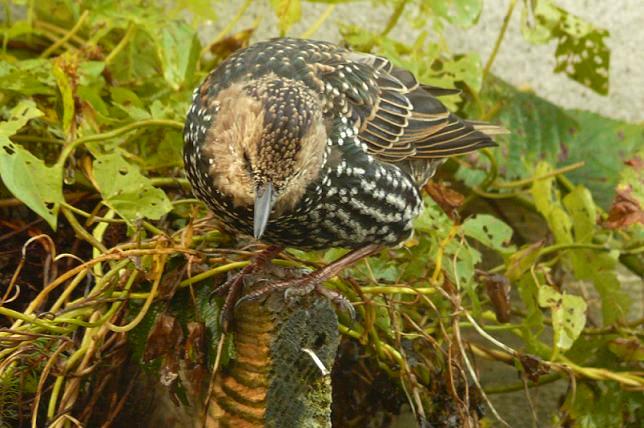
Juvenile Starling, Stumus vulgaris

Juvenile Starling, Stumus vulgaris
I love the Starling in its immature plumage; it looks very much like a frayed piece of carpet or coat. Something cosy, and which might remind you of your grandmother.


"cave-painting" look-al-ike-Starling.


My messy garden is the perfect feeding ground for the Starling. They don't care that the birdtable has collapsed; they never invaded my garden; there is enough natural food avaiilable elsewhere.


Great Tit, Parus major


Female Chaffinch, Fringilla coelebs


Rook, Corvus frugilegus