LEAVE YOUNG BIRDS BE!!


Please, do not hamper a young bird's life by picking it up, and taking it home with you. It is calling its parents to help them in locating it.
After fledgling from the nest, the parent birds will keep feeding it, and look out for it, until it will be able to look after itself.
And the reason you cannot see a parent is because of your own proxomity to the young bird. And while you are ebating if or not you should take the bird home, you keep the parent from giving it well needed nutrition in the form of a meal!


Photos

The photos on this blog are all taken by me. If there is any picture you might want to use for any other than personal use, please drop me a line to the email address shown in the sidebar on the right.
Showing posts with label Hooded Crows. Show all posts

Monday, December 5, 2011

A couple of local Waders and others.

Curlew, Numenius arquata


Hooded Crow, Corvus cornix

I've long been saying that Corvids like the Hooded Crow, Corvus cornix, the Jackdaw, Corvus monedula, the Rook, Corvus frugilegus, and the Red-billed Chough, Pyrrhocorax pyrrhocorax, act more like shorebirds than landbirds. Well, they do here anyway. Sometimes I wonder if they might even end up with webbed feet in a few more millenia? Just look in your local harbour or coastline. Just like you will see the Pied Wagtail, Motacilla alba, there also.
(Yes, this picture is dedicated to fellow blogger, Old Crow. She, like me loves Corvids, but unfortunately for her, the Hooded Crow has not crossed the Atlantic yet.)
The Raven, Corvus corax, likes feeding on coastal areas too. There is one living on the north side of the Sheep'shead Peninsula, which came feeding in a friend's garden during the harsh 2010/2011 winter.


Common Redshank, Tringa totanus

The Redshank is one of my favourite waders; they are so dainty and their bright red-orange legs light up the grey of the slobs.


And further on, another pair of scarlet tights, this time they were hidden from view though.


Black headed Gull, Larus ridibundus


Oystercatcher, Haematopus ostralegus

I've been checking for the Common Teal, Anas creca, to arrive to our little estuary in Dunmanus Bay, but when I thought I spotted the ruddy head of the male, it turned out to be the green head of the male Mallard, Anas platyrrhyncos. This was a bit of a disappointment for me, really.


Sorry that I have not been posting for some time now. I'm going through a bit of a rough patch, really.

Tuesday, September 27, 2011

Grey Heron, Aredea cinerea

This heron flew up from just below the wall along the estuary, and just landed at the other side.

This youngster just wants a little attention

Great Tit, Parus major, searching for grubs amidst the weeds.


All this searching makes one vry thirsty

male House Sparrow, Passer domesticus

And this photo is posted specially for a Canadian blogger, under her Google name of Old Crow. I know that she loves this specie's handsome plumage.
So this Hooded Crow, Corvus Cornix, is fpr you!


Female Chaffinch, Fringilla coelebs.

The number of Chaffs is increasing almost daily; the migrants are arriving from the continent and the Chafflings have now moulted into the adult plumage. They are one of my favourite species, they have very special characters, I think.

Katja, my homehelp, reported that another bird has been killed; she saw a lot of feathers underneath the feeders at the shed.
So I've shifted the big Fatsia japonica next to the shed, hopefully the large leaves will now block the felines.

Tuesday, December 7, 2010

Worries about my Rooks.

Click on the photos for a better view.
This Rook, a juvenile still, has somehow broken the tip of its lower mandible. The upper mandible's tip has now grown downward. Over time the two mandibles will chafe away their original shape as has been happening already.


And here's another Rook, another juvenile unfortunately. He/she also broke the mandible. Very similar break to the first one. This one however looks to be in a worst state health-wise.
The school next door has been closed for many days over the last 2 weeks. This had a major impact on our Rooks, Jackdaws and Hooded Crows, which usual feed there during break times. Blackbirds and Song Thrushes took advantage of this by moving into the garden. The Corvids are back now with the school open today, but I have seen them that much recently. They still feed here, but it seems that the Thrushes have enough power to keep Corvids on the fence.
A full head of feathers like this one is what attracts me to the Rook. (and that cheeky character of course.)

Loss of feathers is apparent in this bird:
it could be suffering from that disease that usually hits Jackdaws. But as these feed togeter, it is very well possible that they got it too. With this cold spell, I assume that the Corvids are moving up and down the countryside in search of food, and we end up with birds other than the local flock.

Wednesday, July 7, 2010

More juvenile Corvids

juvenile Hooded Crow, Corvus cornix
I am not sure how many yong Hoodies there are, but one has taken over the sentry post of the adults, when one will sit on top of the community hall next door inside the school playground. It was anxiously trembling the wings as soon as any adult flew past.


Fledgling Rook, Corvus frugilegus
I am not sure if there are more than 2 juvenile Rooks.


We have (at least) 3 Jackdaw, Corvus monedula youngsters.
I love their curiosity; they are so eager to discover the area around them; where they need to find any nook and cranny in which anything edible can be hidden.

And with Sea Bindweed crawling over and about the shelving on the wall, there are lots of those hiding places for any sort of Invertebrates.


Sweet, isn't it?
Note the light blue of the eyes. These will stay light blue for the 1st year; brown in year two, until they turn to that typical light grey of the adult Jackdaw.


Saturday, June 12, 2010

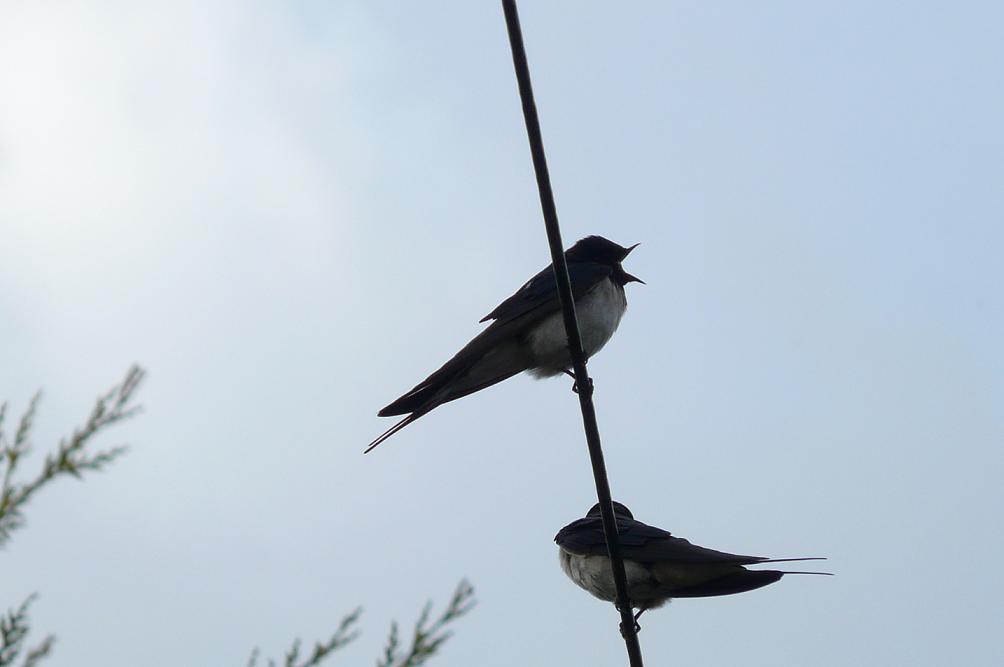
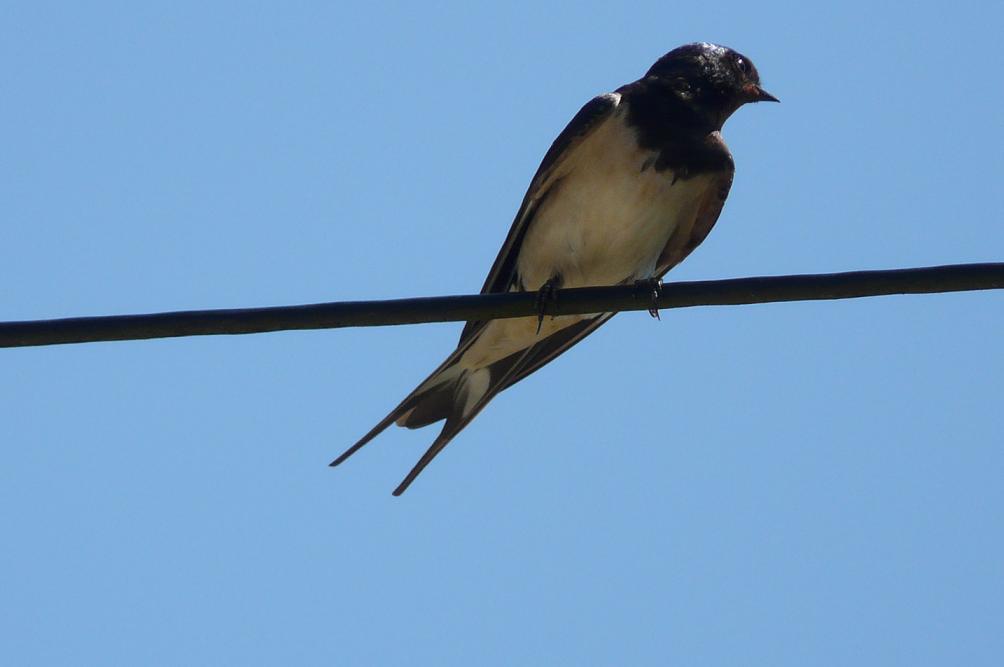
Each spring, Barn Swallows, Hirundo rustica, arrive here and keep flying around the house, en route to a favourite feeding spot, the little field at the school next door. Also, one or two will attack the window of the spare room, probably because it can see the reflection of itself in the window, and needs to attack this competitor. who keeps mimicking the other.
Last month, a pair sat courting on the telephone wire going into the house at the kitchendoor .
I was trying to get things together, as I was going away for a few days, the next day, while these two kept chirruping above my head.
Unfortunately the light was behind them.

Summer is for me the chirruping of Swallows about the house.


Another pair of telephone wire-birds, was making even more noise from the back of the house; the familiar kra-kra of the Hooded Crows.

Tuesday, April 20, 2010

Cosy Jackdaws

Jackdaws, Corvus monedula


Jackdaws have been nesting in the chimneys of the school, next to us, for many years. A high squeak, the other day, startled me, as I was certain it had come from our own chimney. Our chimney used to be out of bounds for the birds, as the Cork county council installed OFCH in our house in the summer of 2008. I had already heard stuff falling down from the chimney in the last week or so, but with many of the Rooks, Jackdaws and the Hooded Crows using the roof & chimney for the opening of snails, it is impossible to say what it was. However it did sound like coming from inside the egg. For the moment we think that there is no nest inside, but we'll see. Mind you, my planter/birdtable will still be host to a number of Jackdaw fledglings, with or without a chimney nest here or not.
Hooded Crows, Corvus cornix


1st winter Rook, Corvus frugilegus


House Sparrow, Passer domesticus
Male
Female
Female