LEAVE YOUNG BIRDS BE!!


Please, do not hamper a young bird's life by picking it up, and taking it home with you. It is calling its parents to help them in locating it.
After fledgling from the nest, the parent birds will keep feeding it, and look out for it, until it will be able to look after itself.
And the reason you cannot see a parent is because of your own proxomity to the young bird. And while you are ebating if or not you should take the bird home, you keep the parent from giving it well needed nutrition in the form of a meal!


Photos

The photos on this blog are all taken by me. If there is any picture you might want to use for any other than personal use, please drop me a line to the email address shown in the sidebar on the right.
Showing posts with label Bird behaviour. Show all posts

Thursday, December 2, 2010

Strange Mute Swan behaviour in Ballydehob.

Mute Swan, Cygnus olor
Cob (male)


Pen (female)

Last week, I was in Ballydehob with two of the girls from respite in Bantry. We stopped at the bottle banks, at the narrow end of the estuary. Here a few herring and Black headed Gulls, Mallards and Mute Swans patrol the water. When I went a little bit down a small slip into the water, the Swans started to become curious and came to have a look. They were waiting for a few chunks of bread, obviously. Something they won't get from me. I should have raided the kitchen for wilted lettuce, or some fruit.

As it was, Mr. Cob was having none of this waiting and started climbing out of the water. He waddled slowly towards me, and I kept a sure distance between him and me. He was not hissing, but he was not happy either.
His mate had left the water also by now, but he still waddled towards me. I was back on the road by now, and she started quietly feeding on the grass. I liked her approach: Ok, if you don't come and feed me, I'll do it myself!
Mind you, I was well aware that he could kill me with a single smash of his wing and neck. I was not taking any chances. I was however interested in why he reacted differently to me than to the two girls behind and next to me.

There were no cygnets to be seen, so he was not defending these.

Eventually, he joined her, even though it was against his principle that humans are on this planet only to feed the waterfowl.


Pen feeding happily on the left; the cob, on the right, is just nibbling a little snack. you can see at her posture that she trusted us, while he was still a bit on edge and still unsure of what to think of me.

pen, grazing.

cob

pen

I can only find one reason for his behaviour of singling me out from us three girls. There was one major difference between us of course, and that is that he would have seen a "short square-ish predator" and perhaps he did not recognise me as a vertical human, and was it all more about defending his territory? he did grunt now and then. Something was weird about it. he was not simply begging for food. Which is what I expected from him.


I was eager to see some waders, and I was also disappointed not to see any Teal. So we walked on, and crossed underneath the old railway bridge towards the little footbridge.


Hooded Crow, Corvus cornix, examining this bicycle underneath the old West Cork Railway Bridge.


Pair of Mallards, Anas platyrrhyncos.

Dinner for Two.
Blackheaded Gull, Larus ridibundus.


Little Egret, Egretta garzetta


Beyond the Little Egret was this wader. It was too far off for me to identify it. Neither could I just the size. I had no idea of the distance either. Could be a Curlew. I had missd seeing waders here, but the road stopped. The estuary, and the water didn't of course.
Curlew?

Opposite the West Cork Hotel in Skibbereen we found this Grey Heron, Andea cinerea, was on the lookout for its lunch in the river Ilen below it.

And finally, the two lovely girls who brought me here
Catherine and Maura, 2 of the staff at respite.

I had hoped to go to Killarney this time, but there was no way we would be able to with all the black ice on the road. Even going to Ballydehob, about 22km. from Bantry, we still had to wait until midday before it was safe enough to hit the road. Perhaps next time?

Tuesday, August 24, 2010

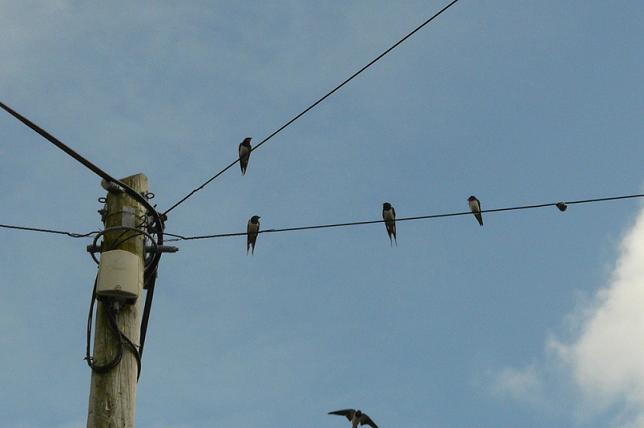
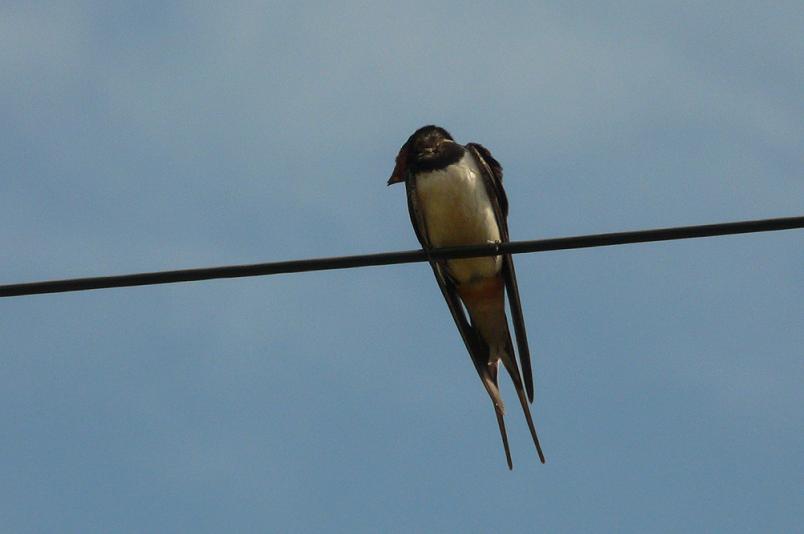
Barn Swallow, 3 juvenile migrants and their parents.

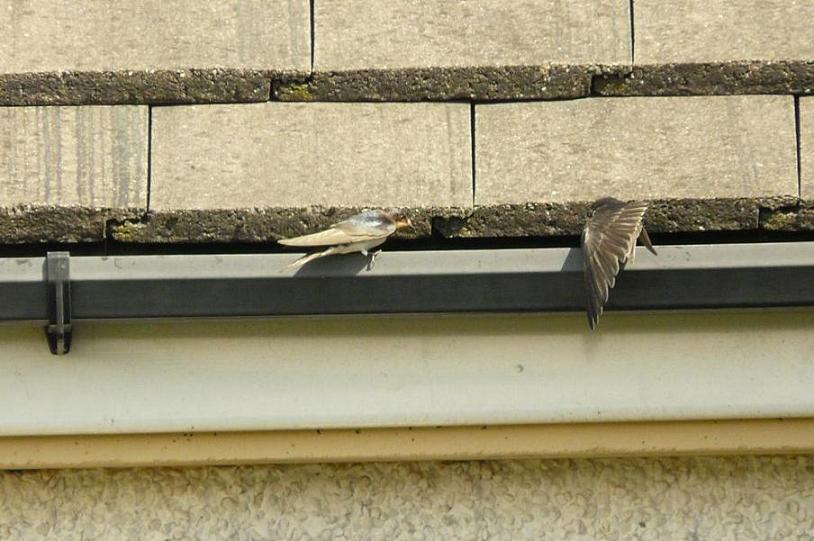
Hungry Swallow fledglings, Hirundo rustica

Getting bored between meals.


Waiting for mum or dad with a juicy insect.


The other day, on my return home from the village, and passing the area where the Swallows nest each year, a group of three kept calling the parents for food. I was delighted! They reared 6 chicks earlier this summer, and these three had still enough time to fatten up and get enough flight experience, before heading all the way to South Africa.


It was too windy to get out along my local patch, and I ended up between the nettles and bramble in my backgarden, as usual, with my macro-lens, to check upon the local crawlies. A lot of chittering made me look up from the foliage, and it was soon clear that the Swallow family had chosen our roofs as vantage point.


Our neighbour, Kevin, died suddenly, 2 weeks ago, and it is perhaps fitting that these young Swallows would bring these 3 young lives to the roof of his, and our, house. The roof, which sheltered him from 2000 till now. he was always surprised whenever I'd find (and photograph, things like Redshank, Persicaria maculosa or Scarlet Pimpernel, Anagallis arvensis, among the bricks of our path.


Hiding?

The parents kept flying to and fro with nice Insects, Flies or Moths, for the demanding youngsters, and in doing so, they would fly incredibly low over my garden and where I was sitting. Dipping to say 1.50metre or even lower,(I have no idea how "low I've sunk from my 1.70 metre as standing height" to my current "sitting height in my wheels.") they would just skim over my hair. It is lovely feling that over your head. And at a certain moment I left the camera for what she is, and just sat still and enjoyed the spectacle. All too soon, they would leave our shores again.
(To be honest, that time is not long off- the weather has really turned autumnal!

Thursday, April 29, 2010

Jackdaw, Corvus monedula

Jackdaws have these lovely and iconic eyes, I always think. Many Corvids, (Rooks, Raven, Magpies and Hooded Crows, and the Jay have black eyes, which, apart for the Jay, have what look like black eyes, but which can have a lovely blue shine over them.


Rook, Corvus Frugilega


A few pairs of Jackdaws nest in this, and other, chimneys of the --very pink--school next door. For a moment I thought we had a pair too, when I heard some noises up inside the chimney. But that was false alarm.


Most of the birds are busy elsewhere at the moment, courting, building nests, laying eggs, incubating and eventually raising those noisy chicks. It is a kind of calm before the storm; in summer the planter will be packed with mainly little House Sparrows, juvenile Jackdaws and others will try and try and find a bit to eat here too.

Male House Sparrow, Passer domesticus
So many girls to chose from...
Female house Sparrows, Passer domesticus


Robin, Erithacus rubecula


Collared Dove,Streptopelia decaocto


Male Chaffinch, Fringilla coelebs


The Great Tits and Blue Tits are nesting nearby; the Blues inside a gap in a wall in front of our house. The county council built this wall along the path to our house. If it wasn't there we would fall down the "cliff face" of lime stone. We live on a hill and the garden in front of us, is a few levels below us, halfway the hill. It is a good wall for the birds; at the back is a garden below.
Great Tit, Parus major

Blue Tit, Parus caeruleus


A while back I posted pictures of a Blue Tit with an eye' problem. According to Niall Hatch at Birdwatch Ireland, it looks very much like an eye infection which is common in House Finches in North America.
If so, she'd get blind and as we all know, a blind bird is a dead bird. I am hugely surprised to still see her, and I haven't yet seen any signs of weakening in her. Mind you, it is hard to tell without the aid of photos, which bird is which. If she is the one nesting, then I fear the most for her chicks. I'd never expected her to be alive still. I need to find out more about the infection. Any links, info or whatever is helpful. Below this post is a comment box. Please leave the message there.