LEAVE YOUNG BIRDS BE!!


Please, do not hamper a young bird's life by picking it up, and taking it home with you. It is calling its parents to help them in locating it.
After fledgling from the nest, the parent birds will keep feeding it, and look out for it, until it will be able to look after itself.
And the reason you cannot see a parent is because of your own proxomity to the young bird. And while you are ebating if or not you should take the bird home, you keep the parent from giving it well needed nutrition in the form of a meal!


Photos

The photos on this blog are all taken by me. If there is any picture you might want to use for any other than personal use, please drop me a line to the email address shown in the sidebar on the right.
Showing posts with label bantry harbour. Show all posts

Tuesday, October 26, 2010

Cormorant, Phalacrocorax carbo
There was not much wildlife to see, so I focussed on these pictures instead.
A few years ago, Cork county council built a walkway from the harbour in Bantry town, to Newtown, a newer part of the town. It passes around the headland at the beach, further eastwards. The last bit, where it should connect to the council estate in Newtown, is still not finished, but it is used quite a lot already. In this climate of healthy living and fears of an obese nation, creating more interesting (dog) walks. The other plan was to connect Bantry harbour with the Bantry airstrip, about 1/2 mile from the Abbey at Bantry's cemetry. This walkway was started but itdoes just hug the corner, where they built a new slipway. I understood that there are disagreements with the landowner(s) of the land in-between. Whenever I am in respite in Bantry, I often go to the airstrip, to brave the strong winds in the hope of spotting those animals which like it there. I just pray that one day these walkways can be finished. I'm a bit sick of having to turn around when I cannot go any further.

Anyway, here's just a few pictures from the Abbey.


View over to Harbour View from the Abbey.


Harbour View.
We first lived in the white building on the right, (middle floor, 2 windows on the right) with Earthwatch on the ground floor, in those days. We also lived in the last (tall) building on the left, (groundfloor-2 windows on the right, which you cannot see) This used to be Hotel Terminus. The name came from the railway terminal which was at the pier about 200 metre from the Hotel. The low building is now a hostel.
There are still bits visible from the old terminal, The bottle banks are now housed among these old walls. It is a bit of a dead zone of the town.

These are taken at Lough Hyne, near Skibbereen, Lough Hyne is Europe's 1st marine nature reserve.
It is sad to know that it is also Ireland's only Marine nature reserve.


Herb Robert, Geranium robertianum.

Monday, December 14, 2009

Herring, and Blackheaded Gulls

These pictures are from last month, when I spend a few hours observing these immature Herring Gulls, Larus argentatus. It was nice and dry during this time, although the wind did bother me a little.

The harbour master kept a check on business and yet it was not bothered by my approach. It stayed where it was while the other two kept going to and fro-a game of flying off and landing again-


Sometimes they were on terra firma just long enough for the shutter to close, like here when they thought giving the master a few extra eyes might win them a few points.


A little further, near the old pier, I took some time to watch a number of Blackheaded Gulls, Larus ridibundus, a much smaller specie than the Herring Gull.

This Blackeaded Gull, Larus ridibundus, was the proud owner of its own island. peace didn't last long though; with the wind speed and water levels rising, real estate like this became sought after by more of its specie.


Not easy to keep hold of what you got!
A young Herring Gull, Larus argentatus,


The wind was picking up fast and the new tide was coming in also; This Blackheaded Gull stood on top of a bit of rock,, and looked very vulnerable.

Blackheaded Gull, Larus ridibundus.
the water kept swirling around its feet, and I caught this one in a moment of shame perhaps, that it was too scared to look at all this water getting higher and higher.
Eventually, the Gull did look down and the "shock" of all the water has it loose its balance. Lol.

Thursday, February 19, 2009

Some more birds from last year.

What I miss most, being without my sweet camera, is the trips out to the bay. I haven't been able to get my wheels to move themselves to the bay. So I found it only fitting to add a few pictures of the birds in or at the water-side.

Anyway, I've promised Old Crow to post a few Jackdaws, so these I have here also.

When we moved in in 2000/01 we would get a flock of Finches move in to come and feed in our garden for the winter before leaving again in March/April. The flock would consist of Goldfinches, Siskins, and Greenfinches. Male Chaffinches would be around the garden already, all year around and others would arrive from the continent. Flocks of Chaffinches would leave from Belgium, from where the females would leave first and the males would come later.
The flock of Fiches did not show up in October of 2006/07 and instead of arriving before winter, they arrived in March/April 2007, and to my surprise they stayed to breed. I need to add that this was a much smaller flock than the one which used to overwinter here.
2 pairs of each species did visit during 2007, at times, and these were the only ones I would be seeing at a time. A far cry from the 6 Siskins hanging at the peanutfeeder in the early years. Last year I did not see much of them, they might show only now and then until say, summer, and from that time I haven't seen any Siskin, Greenfinch or Goldfinch. However, that is the charm of birds. It is what they decide to do! Not what I want!

My Chaffinches were crying out to be added to today's post too, as they do each day.
So, this was last March.


Female Chaffinch


Jackdaw,


Here are a Mute Swan and two Redshank, one of which is so curious it needs to have a closer look at its mate. in Bantry harbour.


And two young Mute Swan, Cygnets.


Also, and why not, two of last year's pics of Nina.

Friday, November 14, 2008

Hooded Crows, Rooks, and an Oxford dictionary

The Hooded Crow photos are still from our stay in Bantry. The ten Hooded Crows visiting the harbour and its nearby area were hard to photograph most times, with the sky overcast during those days, yet sometimes I got lucky. Nothing special, just the best Lumix and I could do.


One of the difficult things in Corvid photography, apart from the Jay, is that often you end up with a fairly 'dead' photo when all you've got is a black head and no visible eye. I'd love to meet up with a Chough one day to get that funny Red Eye into my photo.
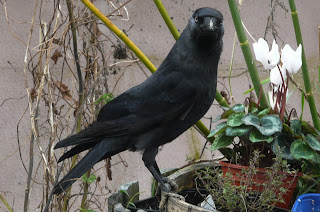
The Jackdaw has its own remarkable eye ring, of course. To illustrate this, I got you another original of our top model, JJ. And it seems he has no trouble in finding ways to amuse me.
Just a taster of more photos to come:
And the 'blue' eye of the Hooded Crow, which isn't blue at all, but it was reflecting the sky in this way with the Sun shining onto it. It adds a kind of sparkle to it.


This spring I passed an area at the harbour in town where the recycling 'banks' are situated and it was these Rooks which were taking advantage of the many people which would still leave their bags of household rubbish there. God knows what the birds-and other local wildlife- are getting hold of! Just thinking of all these fast food containers, convenient food packaging and other chemical harbouring solids, makes me shiver. Mind you, it could also have been the litter from one of the late night walkers or fast food fan across the harbour and that it had just been dropped casually.
I cook without salt myself, and only use black pepper at a later stage. I might be married to a salt addict for 28 years, this does not mean that I would have to add it to my food from the start.
The Rooks were eyeing each other and this food wrapping which was lying in the middle of the road. It was amusing to watch them, how they were waiting for the other to make the first move and trying to take it from the opponent, once one had made that crucial first move.


I love how the bib of the Hooded Crow stands out in this photo; one of its most prominent features. It always reminds me of my ink days, when I used to draw or and also paint with black Indian ink. It was not rare to end up with big marks on paper suddenly, and it was not too far removed from the Hooded Crow's bib.
I wonder if size is a mark of strength for the females when choosing on a strong father for her brood?
The Irish name for Hooded Crows is also Grey Crow which does not really describe him, in my view. However, if you'd compare it with a Carrion Crow, then yes, yuo'd soon talk of the grey one. But with no Carrions here, was there a need to distinguish it with its own, comparable name? or is it from the Celtic language and was it used in other Celtic areas where you do see the two in the one area sometimes, like in certain places in Scotland. On our island we do not see the 'Black' Crow at all. Or, if so, it might be on one or two places on the east coast.

When we moved to Ireland, in 1983, we had only one dictionary with us, a wonderful Oxford English dictionary in hardback, which I had bought 8 years earlier in the UK somewhere. Why I had not brought a Dutch-English one, I have no idea. I had only a few Dutch books with me, a few real treasures. (most are lost now.) We only had a small second hand Peugeot to pack with all we were going to need for one year. A year later I went to pak the rest of our stuff, giving a lot of it to friends in Holland before the big truck came to take it away.

My mum-also an-English-language freak--(who had bought the same Oxford when we were in England together) sent me a set of Dutch/French & French Dutch and the Dutch- English/ English Dutch in paperback. The mistakes in the Dutch-English is amazing and one day, when I've got the time, I will compile a list of certain mis-translations which I have met up until now. One of these is on the Hooded Crow, which is translated as "Spotted" Crow.
Whichever way I look at them, I cannot spot any spot on them.


The Rooks at home are really very predictable- they will hop from one divider on the shelf to the next, looking down onto the planter (birdtable) casually and innocently, before hopping bacck and to and fro for another two or three times.
The temporariry addition of Cyclamen to the planter-whose visual effect or obsatruction does keep cats from jumping up, has been making life difficult for the Corvid family. The Rooks, the Jackdaws and the Hooded Crows, they all had to take a step back.
JJ has come daily though. He would manage to throw the plants over, resulting in me having to get outside again every time he had been here.
The idea is that the Cyclamen go into a windowbox for on the shelf, which would then 'lift' that dark area, whenever it has been raing and the wall gets dark and grey.
Wet weather has prevented me from doing so though.
Instead, dear readers, here is a little .
Rook-video nothing special.