The storm might have passed us, but after more hail, sleet, the temperatures were low enough to keep the flakes frozen in the planter and on any other horizontal surface. This is unusual in our warm corner of the island.
Anyway, as soon as the temperatures rose slightly, rain came our way once again.
My lens managed to peek in between the - still- wet window now and then to capture my little visitors, and I've already got quite a collection of Goldcrest pics. Even got one, out of focus Goldcrest in the Fennel. At least I got it in time, which is a start.
So I've included a few into this slide show, which is just for fun.
Or at least I thought it would be fun, but my, it made me sigh on a very regular basis, as it was not as easy as it made out to be.
Then again, might be better next time? Yeah right! As if.
Not that this one is perfect, far from it. some photos might be a bit off kilter also.
It's at the bottom of the blog.

Showing posts with label birding videos. Show all posts
Showing posts with label birding videos. Show all posts
Wednesday, January 21, 2009

Friday, November 14, 2008
Hooded Crows, Rooks, and an Oxford dictionary
The Hooded Crow photos are still from our stay in Bantry. The ten Hooded Crows visiting the harbour and its nearby area were hard to photograph most times, with the sky overcast during those days, yet sometimes I got lucky. Nothing special, just the best Lumix and I could do.

One of the difficult things in Corvid photography, apart from the Jay, is that often you end up with a fairly 'dead' photo when all you've got is a black head and no visible eye. I'd love to meet up with a Chough one day to get that funny Red Eye into my photo.
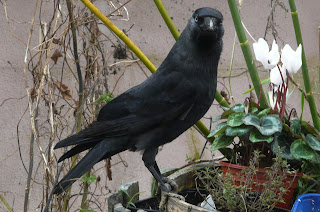
The Jackdaw has its own remarkable eye ring, of course. To illustrate this, I got you another original of our top model, JJ. And it seems he has no trouble in finding ways to amuse me.
Just a taster of more photos to come:
And the 'blue' eye of the Hooded Crow, which isn't blue at all, but it was reflecting the sky in this way with the Sun shining onto it. It adds a kind of sparkle to it.

This spring I passed an area at the harbour in town where the recycling 'banks' are situated and it was these Rooks which were taking advantage of the many people which would still leave their bags of household rubbish there. God knows what the birds-and other local wildlife- are getting hold of! Just thinking of all these fast food containers, convenient food packaging and other chemical harbouring solids, makes me shiver. Mind you, it could also have been the litter from one of the late night walkers or fast food fan across the harbour and that it had just been dropped casually.
I cook without salt myself, and only use black pepper at a later stage. I might be married to a salt addict for 28 years, this does not mean that I would have to add it to my food from the start.
The Rooks were eyeing each other and this food wrapping which was lying in the middle of the road. It was amusing to watch them, how they were waiting for the other to make the first move and trying to take it from the opponent, once one had made that crucial first move.


I love how the bib of the Hooded Crow stands out in this photo; one of its most prominent features. It always reminds me of my ink days, when I used to draw or and also paint with black Indian ink. It was not rare to end up with big marks on paper suddenly, and it was not too far removed from the Hooded Crow's bib.
I wonder if size is a mark of strength for the females when choosing on a strong father for her brood?
The Irish name for Hooded Crows is also Grey Crow which does not really describe him, in my view. However, if you'd compare it with a Carrion Crow, then yes, yuo'd soon talk of the grey one. But with no Carrions here, was there a need to distinguish it with its own, comparable name? or is it from the Celtic language and was it used in other Celtic areas where you do see the two in the one area sometimes, like in certain places in Scotland. On our island we do not see the 'Black' Crow at all. Or, if so, it might be on one or two places on the east coast.
When we moved to Ireland, in 1983, we had only one dictionary with us, a wonderful Oxford English dictionary in hardback, which I had bought 8 years earlier in the UK somewhere. Why I had not brought a Dutch-English one, I have no idea. I had only a few Dutch books with me, a few real treasures. (most are lost now.) We only had a small second hand Peugeot to pack with all we were going to need for one year. A year later I went to pak the rest of our stuff, giving a lot of it to friends in Holland before the big truck came to take it away.
My mum-also an-English-language freak--(who had bought the same Oxford when we were in England together) sent me a set of Dutch/French & French Dutch and the Dutch- English/ English Dutch in paperback. The mistakes in the Dutch-English is amazing and one day, when I've got the time, I will compile a list of certain mis-translations which I have met up until now. One of these is on the Hooded Crow, which is translated as "Spotted" Crow.
Whichever way I look at them, I cannot spot any spot on them.


The Rooks at home are really very predictable- they will hop from one divider on the shelf to the next, looking down onto the planter (birdtable) casually and innocently, before hopping bacck and to and fro for another two or three times.
The temporariry addition of Cyclamen to the planter-whose visual effect or obsatruction does keep cats from jumping up, has been making life difficult for the Corvid family. The Rooks, the Jackdaws and the Hooded Crows, they all had to take a step back.
JJ has come daily though. He would manage to throw the plants over, resulting in me having to get outside again every time he had been here.
The idea is that the Cyclamen go into a windowbox for on the shelf, which would then 'lift' that dark area, whenever it has been raing and the wall gets dark and grey.
Wet weather has prevented me from doing so though.
Instead, dear readers, here is a little .
Rook-video nothing special.

One of the difficult things in Corvid photography, apart from the Jay, is that often you end up with a fairly 'dead' photo when all you've got is a black head and no visible eye. I'd love to meet up with a Chough one day to get that funny Red Eye into my photo.
The Jackdaw has its own remarkable eye ring, of course. To illustrate this, I got you another original of our top model, JJ. And it seems he has no trouble in finding ways to amuse me.
Just a taster of more photos to come:

And the 'blue' eye of the Hooded Crow, which isn't blue at all, but it was reflecting the sky in this way with the Sun shining onto it. It adds a kind of sparkle to it.

This spring I passed an area at the harbour in town where the recycling 'banks' are situated and it was these Rooks which were taking advantage of the many people which would still leave their bags of household rubbish there. God knows what the birds-and other local wildlife- are getting hold of! Just thinking of all these fast food containers, convenient food packaging and other chemical harbouring solids, makes me shiver. Mind you, it could also have been the litter from one of the late night walkers or fast food fan across the harbour and that it had just been dropped casually.
I cook without salt myself, and only use black pepper at a later stage. I might be married to a salt addict for 28 years, this does not mean that I would have to add it to my food from the start.
The Rooks were eyeing each other and this food wrapping which was lying in the middle of the road. It was amusing to watch them, how they were waiting for the other to make the first move and trying to take it from the opponent, once one had made that crucial first move.


I love how the bib of the Hooded Crow stands out in this photo; one of its most prominent features. It always reminds me of my ink days, when I used to draw or and also paint with black Indian ink. It was not rare to end up with big marks on paper suddenly, and it was not too far removed from the Hooded Crow's bib.
I wonder if size is a mark of strength for the females when choosing on a strong father for her brood?
The Irish name for Hooded Crows is also Grey Crow which does not really describe him, in my view. However, if you'd compare it with a Carrion Crow, then yes, yuo'd soon talk of the grey one. But with no Carrions here, was there a need to distinguish it with its own, comparable name? or is it from the Celtic language and was it used in other Celtic areas where you do see the two in the one area sometimes, like in certain places in Scotland. On our island we do not see the 'Black' Crow at all. Or, if so, it might be on one or two places on the east coast.
When we moved to Ireland, in 1983, we had only one dictionary with us, a wonderful Oxford English dictionary in hardback, which I had bought 8 years earlier in the UK somewhere. Why I had not brought a Dutch-English one, I have no idea. I had only a few Dutch books with me, a few real treasures. (most are lost now.) We only had a small second hand Peugeot to pack with all we were going to need for one year. A year later I went to pak the rest of our stuff, giving a lot of it to friends in Holland before the big truck came to take it away.
My mum-also an-English-language freak--(who had bought the same Oxford when we were in England together) sent me a set of Dutch/French & French Dutch and the Dutch- English/ English Dutch in paperback. The mistakes in the Dutch-English is amazing and one day, when I've got the time, I will compile a list of certain mis-translations which I have met up until now. One of these is on the Hooded Crow, which is translated as "Spotted" Crow.
Whichever way I look at them, I cannot spot any spot on them.


The Rooks at home are really very predictable- they will hop from one divider on the shelf to the next, looking down onto the planter (birdtable) casually and innocently, before hopping bacck and to and fro for another two or three times.
The temporariry addition of Cyclamen to the planter-whose visual effect or obsatruction does keep cats from jumping up, has been making life difficult for the Corvid family. The Rooks, the Jackdaws and the Hooded Crows, they all had to take a step back.
JJ has come daily though. He would manage to throw the plants over, resulting in me having to get outside again every time he had been here.
The idea is that the Cyclamen go into a windowbox for on the shelf, which would then 'lift' that dark area, whenever it has been raing and the wall gets dark and grey.
Wet weather has prevented me from doing so though.
Instead, dear readers, here is a little .
Rook-video nothing special.
Wednesday, November 12, 2008
Staying safe when you go birding on wheels
Most of us can still remember we have to walk(to school) on the right side of the road, and should be facing the oncoming traffic. In countries where they drive on the left, of course- in others like on the European continent, it is simply the other way around.
In fact, I'd trouble every time I returned from a holiday in the UK, and I was crossing the road. I would automatically look to the right first, and this has created some near misses more than a couple of times.
Once I decided on doing a post on road safety for wheelie birders, I asked both the RSA or road safety authority in Ireland(RSA) and the Irish Wheelchair Association (IWA) on to which side of the road we should stick to when going for a spot of birding or (other) wildlife watching.
This is the reply from the RSA
and that of the IWA was very much similar. I would like to add though that on narrow or on busy roads, I switch to the left whenever I am approaching a bend in the road.
Not that I am criss-crossing constantly, but I find it very dangerous to stay on the right when there is a bend to the right coming up. The oncoming cars have no idea that I am there, yet if I change to the left hand side, they can see me from the (right) side and drivers on the left side, coming up behind me, can see me also.
It is not only bends which makes me change sides though:
these do too,


The (Cork)county council fails to see that the edge of the road on the right side is about 80 cm further to the right than that it is, as used by vehicles on this road at the moment.
And if I as a wheelie go over this road and keep as much to the side as is possible, I am also 80cmto the left of there where you can see a bit of even-ness on the road, almost 1.5 metres from the grass!
When I was in Bantry, I thought it best to keep to the pavement along the N71, the main Cork-Kenmare/Glengarriff road when I was looking for a bit of autumn colour. However, the problem with these pavements is always- you might be able to get up onto one, but will you be able to get off it as well?? And with the pavement running out of town, I had absolutely no idea, and this kept milling in the head while I was going down.
I was on my way to the Abbey. At the other side of the road, a kind of large pond was created which is tidal and gives the idea of a nice lake there where the Bantry boat club has its clubhouse.

Here you get a glimpse of the cemetery which looks out onto the bay, and being on a slope, the view must be excellent! Lovely birding from there too in your days of peace.

a new life waiting for the wind.

A friend had suggested the gardens of Bantry House as an alternative for miss Lumix (my camera) but I wanted to show her that access is hopeless along all the gravel paths.
I might not get into the gardens, I was taken by this lovely 'Hobbit tree'

Bantry House is on the slope here, where it still has a very large gun outside, facing the bay.

These are across from the road, from the Abbey, a picture of The Sugar Loaf Mountain near Glengarriff, and a house on the island.


Here you can see the Sugar Loaf Mountain and the Hungry Hill Mountain which stands at the end of the Beara Peninsula, which lines the Bantry Bay on the north side.


The council has started making a walkway along Bantry Bay, 'just' around the town so to speak from the old pier to New Town. Although they had started building this, work has stopped because of disagreement over ownership of the land. In short, this can take a long time to be finished.
It would be a safe way to go birding, although I have no idea how easy the access will be at the other end. I still have to enquire if it is accessible anyway.
I had planned to go and take a look, that afternoon, after returning from the Abbey. However, with fingers like icicles, I needed a glove first. So after finishing my drink in the hotel, I went to the shop first. I told the girl there, colour is no issue, but I need to be able to operate the camera. So for € 7.-- I got a pair, of which the left-hand one is up at Rehab, seeking a left- handed one hander.
It was by then already past four and as you can see in my last picture, the evening was setting fast.
And the next day I totally forgot. Only when seeing this photo upon my return home did I spot the walkway which I had failed to investigate.


In fact, I'd trouble every time I returned from a holiday in the UK, and I was crossing the road. I would automatically look to the right first, and this has created some near misses more than a couple of times.
Once I decided on doing a post on road safety for wheelie birders, I asked both the RSA or road safety authority in Ireland(RSA) and the Irish Wheelchair Association (IWA) on to which side of the road we should stick to when going for a spot of birding or (other) wildlife watching.
This is the reply from the RSA
and that of the IWA was very much similar. I would like to add though that on narrow or on busy roads, I switch to the left whenever I am approaching a bend in the road.
Not that I am criss-crossing constantly, but I find it very dangerous to stay on the right when there is a bend to the right coming up. The oncoming cars have no idea that I am there, yet if I change to the left hand side, they can see me from the (right) side and drivers on the left side, coming up behind me, can see me also.
It is not only bends which makes me change sides though:
these do too,


The (Cork)county council fails to see that the edge of the road on the right side is about 80 cm further to the right than that it is, as used by vehicles on this road at the moment.
And if I as a wheelie go over this road and keep as much to the side as is possible, I am also 80cmto the left of there where you can see a bit of even-ness on the road, almost 1.5 metres from the grass!
When I was in Bantry, I thought it best to keep to the pavement along the N71, the main Cork-Kenmare/Glengarriff road when I was looking for a bit of autumn colour. However, the problem with these pavements is always- you might be able to get up onto one, but will you be able to get off it as well?? And with the pavement running out of town, I had absolutely no idea, and this kept milling in the head while I was going down.
I was on my way to the Abbey. At the other side of the road, a kind of large pond was created which is tidal and gives the idea of a nice lake there where the Bantry boat club has its clubhouse.

Here you get a glimpse of the cemetery which looks out onto the bay, and being on a slope, the view must be excellent! Lovely birding from there too in your days of peace.

a new life waiting for the wind.

A friend had suggested the gardens of Bantry House as an alternative for miss Lumix (my camera) but I wanted to show her that access is hopeless along all the gravel paths.
I might not get into the gardens, I was taken by this lovely 'Hobbit tree'

Bantry House is on the slope here, where it still has a very large gun outside, facing the bay.

These are across from the road, from the Abbey, a picture of The Sugar Loaf Mountain near Glengarriff, and a house on the island.


Here you can see the Sugar Loaf Mountain and the Hungry Hill Mountain which stands at the end of the Beara Peninsula, which lines the Bantry Bay on the north side.


The council has started making a walkway along Bantry Bay, 'just' around the town so to speak from the old pier to New Town. Although they had started building this, work has stopped because of disagreement over ownership of the land. In short, this can take a long time to be finished.
It would be a safe way to go birding, although I have no idea how easy the access will be at the other end. I still have to enquire if it is accessible anyway.
I had planned to go and take a look, that afternoon, after returning from the Abbey. However, with fingers like icicles, I needed a glove first. So after finishing my drink in the hotel, I went to the shop first. I told the girl there, colour is no issue, but I need to be able to operate the camera. So for € 7.-- I got a pair, of which the left-hand one is up at Rehab, seeking a left- handed one hander.
It was by then already past four and as you can see in my last picture, the evening was setting fast.
And the next day I totally forgot. Only when seeing this photo upon my return home did I spot the walkway which I had failed to investigate.


Monday, October 27, 2008
Disabled Birding Ireland?
Birding along a busy road is not ideal, yet it could be the best option.

I am currently collecting some more info on access to reserves here in West Cork and also further afield.
Perhaps I can try and use this blog to see if we can perhaps start a site and organisation similar to the Disabled Birders Association depending on the information I can assemble.And I also hope that Darlene at Comfortablebirding for All and I can work together in the collecting of data.
Living in such a beautiful area of this island, it is a real pity that I cannot fully enjoy those places where habitat and wildlife go hand in hand as it is supposed to in the Parks and Nature Reserves and where birdwatching is often rewarded with species you perhaps won't see along the road or in our gardens.
It is ridiculous I think that I am already looking forward to moving away from this beautiful area and returning to the Netherlands, the country I was born and grew up until we, my husband and I, moved to Ireland to escape the hectic life in the small country which is Holland.
It is the size of Munster, which is only about a quarter of the Republic of Ireland (more or less) yet it has almost 16 million people leaving not much room for wildlife, you would think? Actually this is not true. For one it has many places where yuo can still observe wildlife and birds. Besides, Holland has a great history in catering for people with disabilities. I got mine already when I was 9 years old. And I got my first bird feeder at 10 or 11 years old, when I got a little window feeder. Immediately behind our house was a very large forest, so birds aplenty.
Here in West Cork I'm having great areas with lovely habitat around me too. Yet I keep having problems in getting into or onto these.
It can be very awkward keeping to the side on a main road, when your Local patch has surfaces like these.

It had worsened again after all the rain and the council started patching up the roads again and I should be delighted but the problem is that,

these patches or Cow dung as we tend to call them, will have washed away after the next rains. And until then? They are the source of even more pain in my back as I have to go over them on my way to the bay.


I am currently collecting some more info on access to reserves here in West Cork and also further afield.
Perhaps I can try and use this blog to see if we can perhaps start a site and organisation similar to the Disabled Birders Association depending on the information I can assemble.And I also hope that Darlene at Comfortablebirding for All and I can work together in the collecting of data.
Living in such a beautiful area of this island, it is a real pity that I cannot fully enjoy those places where habitat and wildlife go hand in hand as it is supposed to in the Parks and Nature Reserves and where birdwatching is often rewarded with species you perhaps won't see along the road or in our gardens.
It is ridiculous I think that I am already looking forward to moving away from this beautiful area and returning to the Netherlands, the country I was born and grew up until we, my husband and I, moved to Ireland to escape the hectic life in the small country which is Holland.
It is the size of Munster, which is only about a quarter of the Republic of Ireland (more or less) yet it has almost 16 million people leaving not much room for wildlife, you would think? Actually this is not true. For one it has many places where yuo can still observe wildlife and birds. Besides, Holland has a great history in catering for people with disabilities. I got mine already when I was 9 years old. And I got my first bird feeder at 10 or 11 years old, when I got a little window feeder. Immediately behind our house was a very large forest, so birds aplenty.
Here in West Cork I'm having great areas with lovely habitat around me too. Yet I keep having problems in getting into or onto these.
It can be very awkward keeping to the side on a main road, when your Local patch has surfaces like these.

It had worsened again after all the rain and the council started patching up the roads again and I should be delighted but the problem is that,

these patches or Cow dung as we tend to call them, will have washed away after the next rains. And until then? They are the source of even more pain in my back as I have to go over them on my way to the bay.

Wednesday, October 22, 2008
At long last, a Sparrow Movie after all
I have tried uploading this Sparrow movie several times already, over the course of its existence.
Having failed to do so, I thought it was better if I used Photobucket for this, which already holds a few of my creations and so I think it was about time to add my beloved Sparrows also.
During the summer months I hoped to make a better Sparrow movie than the one linked to this post, but other things took up my time, like the birds in the bay and things like those wonderful Wild Flowers, which I met all along the roads.
A message to Carin and Old Crow: I am sorry, we cannot divulge the secret of the Sparrow pods, hanging in the Fennel, or film these. We like to keep it to ourselves, however you do get the chance to observe the messy feeding habits of the hatched 'products'
Anyway, now that the colony has shrunk again and we are down to numbers between 15 and 7, it is perhaps a good time to remembers those 'other silly Sparrows which kept feeding on the peanut cake, seeds and other bird food spread out on the table.
So Here Are the Sparrows
Having failed to do so, I thought it was better if I used Photobucket for this, which already holds a few of my creations and so I think it was about time to add my beloved Sparrows also.
During the summer months I hoped to make a better Sparrow movie than the one linked to this post, but other things took up my time, like the birds in the bay and things like those wonderful Wild Flowers, which I met all along the roads.
A message to Carin and Old Crow: I am sorry, we cannot divulge the secret of the Sparrow pods, hanging in the Fennel, or film these. We like to keep it to ourselves, however you do get the chance to observe the messy feeding habits of the hatched 'products'
Anyway, now that the colony has shrunk again and we are down to numbers between 15 and 7, it is perhaps a good time to remembers those 'other silly Sparrows which kept feeding on the peanut cake, seeds and other bird food spread out on the table.
So Here Are the Sparrows
Subscribe to:
Posts (Atom)