Soft bedding!
 We have 12 of them now. They have totally shifted over the balance of power. The Rooks, Jackdaws and Hooded Crows, were mostly looking down from the fence at those Black and Brown birds fighting each other for the food. Mind you, it was fascinating to observe those big Corvids, trying to grovel their way into the garden!
In winter, large numbers of Blackbirds and other Thrushes visit Ireland and the UK looking for food and warmth.
Robin, Erithacus rubecula
 All 4 Robins had drawn swords, and although last winter the cold weather made some species forget about territories temporarily, not this time around!
Ah! This coconut shell with peanutcake is mine!
 The Rooks had managed to drop it off its hook, giving the Blackbirds a little ray of well needed fat and protein. They fought each other for the delicacy inside.
Redwing, Turdus ilacus
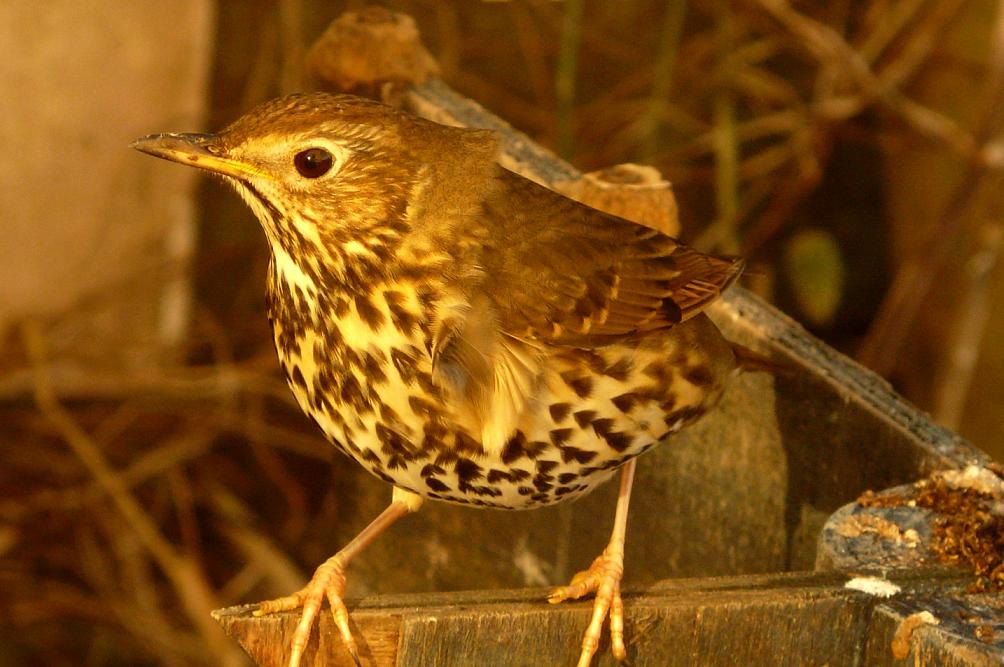
 The Redwing, a little smaller than our native Song Thrush, was quick to respond to those free handouts.
Stand off between one of the Song Thrushes, Turdus philomelos, and a male Blackbird. The prize? Leftover peanutcake and crumbled fatballs. Among the seed.

 Before the snow.
Dunnock, Prunella modularis

Male House Sparrow, Passer domesticus

Male Chaffinch, Fringilla coelebs


Male Blackcap, Sylvia atriciapilla
 Do I see food down there?
In that very cold spell in February, this year, we had a female Blackcap visit the garden until spring. This time, it is the male who needs a good feed. I only discovered him on Christmas Day, when I sat counting the many Blackbirds on the ground, and spotted him down there looking for fallen bits of seed and other food which the Blackbirds might have missed.
After the first snow, I made the big mistake of going outside into the garden to feed the birds. (as you do, right? That is just part of everyday life, right? I did not think that that low covering would be a problem. How wrong I was. Oops. Wheeling over to the 'birdtable' (The Fatsia japonica) I soon realised that I could not get back inside, as my wheels got stuck onto the tracks I had made getting out there. It took me 40 minutes to get back indoors. The distance? A little over a metre! On a certain moment I did have to get out of my wheels and pull her forwards, without pushing her into my legs. Needless to say I almost fell over. Anyway, that was 12 days ago. Today is the first day that I was able to get out ago, after the thaw set in. I was getting claustrophobic, sitting inside all this time. Usually I spent a large amount of time outside, whatever the weather. Even when it was freezing during daytime, in late November/early December, I would still go and settle out in the garden with my thoughts, the birds above and around me.
The thaw has set in with lashing of rain; back to the normal gales and rain. From the south instead of the west. (Atlantic storms with used to be our normal winter weather-pre climate chance-) in other words, no chance for photos through those wet windows.
Eddy, our village shop owner, has helped us out by bringing shopping up to us, during this cold period, a service you only find in these small communities. When I had asked for lard for the peanutcake, I got a six pack of fatballs instead, because he didn't have any. The birds got this for free.
One of the Pied Wagtails, Motacilla alba


Our resident Blue Tits brought a few friends to dinner too.


Territorial bounderies forgotten?